Philosophy — why Inkome exists
Before the buttons and forms, it’s worth knowing what Inkome is trying to do — because every part of the product bends around a few simple beliefs. This page lays them out.
The triangle: Revenue, Cash, and Costs belong together
Most businesses run on three numbers, and almost every tool only shows you one of them.
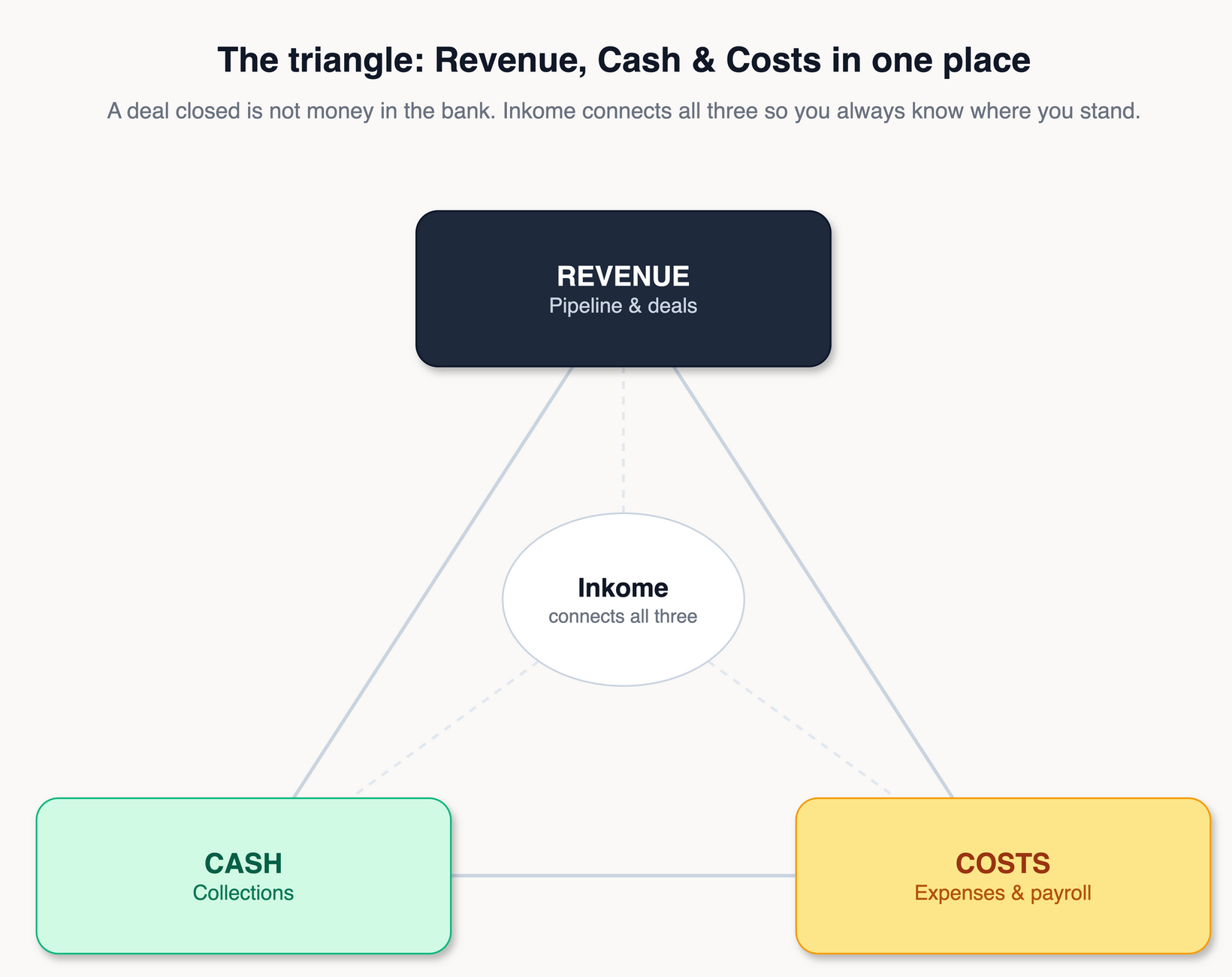
A CRM tracks Revenue — your pipeline, your deals, who’s close to signing. Accounting software tracks Cash — what’s been invoiced and paid. An HR or payroll system tracks Costs — what you’re spending to do the work. Each is useful. None of them shows the whole picture.
That gap has a real cost. A deal marked “won” feels like a win, but a closed deal isn’t money in the bank — the payment might be months out, split across milestones, or stuck. Meanwhile the costs of delivering that deal are landing now. If your pipeline lives in one place and your collections in another and your costs in a third, you can’t actually answer the question that matters: where does my business stand this month?
Inkome connects the three. Revenue, Cash, and Costs sit in one place, tied to the same deals, so the picture is whole and the numbers stay honest.
An operations team you can’t afford to hire
Running a business properly takes a CFO, a Sales Director, an Accountant, and an Analyst. Most founders and small teams can’t afford any of them — so those roles just go unfilled, and the work either doesn’t happen or happens at 1 a.m. in a spreadsheet.
Inkome’s answer is a set of specialized AI agents instead of headcount. There’s a CFO for projections and cash flow, an Analyst for reports and trends, a Sales Director for pipeline strategy, and an Accountant for collections and payments. You talk to them in plain English. They know your data because they’re looking at the same Revenue, Cash, and Costs you are.
Augmentation, not replacement
Inkome is not here to take over. You’re great at your craft — the agents are great at the operations work around it. They cover your blind spots; you keep the judgment.
That distinction shapes the whole product. The AI surfaces what you’d otherwise miss — an overdue collection, a thinning pipeline, a cost that’s quietly grown — but it doesn’t make the call for you. It makes you faster and more informed, not optional.
It speaks your business’s language
A consulting firm has deals. An online store has products. A subscription business has plans. Forcing all of them into the same generic labels makes the software feel like it was built for someone else’s business.
Inkome reshapes its language to fit yours. When you set up a space, you pick a business type, and the whole app re-labels itself — Deals become Products or Plans, Collections become Sales or Revenue, and forms show only the fields that make sense for your vertical. See Dynamic terminology for how that works.
It never forgets
Who owes you money? When is it due? What did this deal actually cost to deliver? Inkome remembers all of it. Every deal, every collection, every cost is tracked and surfaced when you need it — so nothing slips through the cracks while you’re busy doing the actual work.
A note from the author
I built Inkome because I lived the problem. You can be excellent at what you do and still lose the thread on operations — the pipeline drifts, a payment goes uncollected, costs creep up, and you find out a month too late. The tools that were supposed to help each told one-third of the story. I wanted one place that told the whole story, and an assistant that would watch it with me. That’s what this is.
What Inkome is not
To be clear about the boundaries:
- Not a generic AI chatbot. The agents work from your actual business data, not the open internet.
- Not just a CRM. It doesn’t stop at “deal won” — it follows the money to the bank and tracks the cost of delivery.
- Not accounting software. It isn’t a bookkeeping ledger or a tax tool; it won’t file anything for you.
- Not an ERP. No inventory engine, no procurement, no manufacturing resource planning.
- Not a replacement for your judgment. It augments you; the decisions stay yours.
- Not built for large enterprises. It’s for founders and small teams, not org charts with dedicated finance and sales-ops departments.
Prev: Inkome — overview Next: Key concepts: organizations, spaces, the triangle Up: User guide index